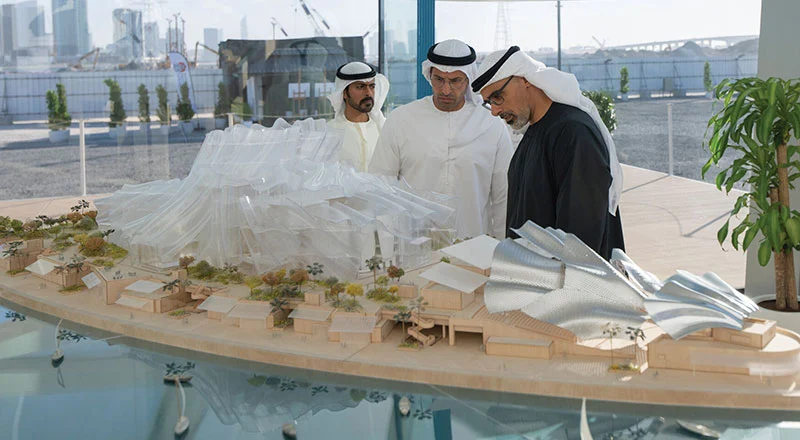
Why branded residences have shifted from marketing garnish to a capital-formation strategy in Abu Dhabi — brand-by-brand positioning, market data, and contrarian risks.
Emerging Branded Residences in Abu Dhabi
What’s being built, why it’s happening now, what the data actually says, what the glossy brochures omit, and where investor edge is hiding in plain sight. The core thesis is simple: branded residences have shifted from “marketing garnish” to a capital formation strategy in Abu Dhabi—because the city is now offering the three ingredients brands and high-net-worth buyers require at the same time: global pull (culture + tourism), legal/regulatory legibility, and investable scarcity in prime districts. The 2024–2026 timing is not coincidence; it’s the convergence of policy upgrades, a maturing international buyer base, and developers learning from Dubai’s playbook—then deliberately choosing a different positioning. [2]
Strategic connection mapping
Cluster A: “Cultural Capital → Trophy Asset” Saadiyat Island[3] is being engineered as a global cultural coastline, not just a beach address. The logic is that museums, curated retail, and a controlled luxury ecosystem pull globally mobile wealth that doesn’t need to “work” locally to justify buying. Aldar explicitly ties its premium residential launches to proximity to Saadiyat’s cultural assets and lifestyle infrastructure. [4] The “elite three” you highlighted—Four Seasons, Nobu, Mandarin Oriental—map neatly onto different investor psychologies: Four Seasons: trust, privacy, governance, generational holding behavior. [5] Mandarin Oriental: service rigor + design credibility + “quiet luxury” buyer profile. [6] Nobu: lifestyle signal + cultural affiliation + scarcity through narrative (restaurant-as-social-anchor). The record-breaking Abu Dhabi sale shows how rapidly that narrative can translate into price discovery when supply is limited. [7] Cluster B: “Financial District → Liquidity + Rental Logic” Al Maryah Island[8] is Abu Dhabi’s finance-and-lifestyle hybrid: home of Abu Dhabi Global Market[9], adjacent to The Galleria Al Maryah Island[10] and Cleveland Clinic Abu Dhabi[11]. The branded pipeline here is less “beach trophy,” more “global-city apartment with service infrastructure.” [12] This is where your “not as elite” brands sit: The St. Regis Residences, Al Maryah Island[13], The Ritz-Carlton Residences, Al Maryah Island[14], W Residences Abu Dhabi - Al Maryah Island[15] and Jumeirah Residences Al Maryah Island[16]. Here, the investor question is not “will this be iconic?”—it’s “will this trade, rent, and hold its premium once the cluster is fully built?” [17] Why the surge starts 2024 onward (and not before) A clean explanation exists, and it’s multi-causal: Foreign ownership threshold: Abu Dhabi’s move to allow foreigners to own freehold in designated investment areas (2019 reform) is a structural prerequisite. It widened the buyer pool, but supply response lags years—especially for branded product that requires licensing, design approvals, and pre-sales choreography. [18] Regulatory consolidation + data credibility: the launch of Abu Dhabi Real Estate Centre[19] (late 2023) and the continued build-out of digital real estate infrastructure through platforms like DARI reduced friction for international investors and professionalized market oversight. That matters more in ultra-luxury than most advisors admit—because buyers at this level are purchasing jurisdictional confidence as much as they’re buying a view. [20] ADGM expansion: ADGM’s jurisdiction was expanded tenfold to include Al Reem Island[21] alongside Al Maryah, citing increased demand from international companies; later updates show material business migration into the expanded jurisdiction. This is the institutional backbone that makes Al Maryah more than a “nice island.” [22] Demand shock, proven by capital flow: foreign direct investment into Abu Dhabi real estate accelerated sharply in 2024–2025, with ADREC reporting a dramatic rise and diverse nationality mix. That’s your investor radar turning on. [23] Tourism megaproject credibility: The Disney theme park and resort announcement on Yas Island (May 2025) is not a “nice headline.” It is the kind of globally legible catalyst that changes long-term confidence curves—especially for buyers who don’t live in the GCC and only allocate capital when a destination feels inevitable. [24]
Projects and brands
Below is the factual project layer (what’s confirmed), followed by the positioning layer (what it implies).
1. Four Seasons Private Residences (Saadiyat)
Project: Four Seasons Private Residences Abu Dhabi at Saadiyat Beach[25]. Developer partner: ALAIN[26] (described as a diversified investment group established in 1996). [5] Delivery signal: set to welcome homeowners in 2029. [5] Scale and mix: 56 villas (including limited beach mansions) and 60 suites (including penthouse and royal residences). [5] Service model: dedicated Four Seasons residential team led by a Residences General Manager; concierge, housekeeping, culinary and wellness services, and ongoing property management are explicitly part of the promise. [5] Positioning insight: This is Abu Dhabi’s “private club” play—gated, low-density beachfront, built for buyers who value privacy and governance more than rental yield. It competes less with Dubai towers and more with global standalones in places like Miami Beach, branded Alpine product, or trophy coastal enclaves. Knight Frank’s global research also notes a rising shift toward standalone branded schemes, which aligns directly with why this format is being launched now. [27]
2. Nobu Residences (Saadiyat)
Project: Nobu Residences Abu Dhabi[28] with 88 homes overlooking major Saadiyat assets. [29] Price discovery milestone (critical): Aldar reported a three-bedroom penthouse sale at AED 137 million; the unit spans 1,430 sqm and set a new benchmark price per sqm (over AED 96,000 per sqm). [30] Delivery: Aldar stated completion in Q2 2027. [31] Product stack (as described by Aldar): apartments, penthouses, lofts, sky villas + a Nobu hotel and signature F&B components. [32] Notable timeline drift: earlier partnership disclosures referenced a 165-room hotel expected to open in 2026; later communications describe a different key count and a 2027 completion timeline for the development. Investors should treat this as normal project evolution—but price underwriting should include schedule risk. [33] Positioning insight: Nobu is less “heritage hotel” and more “cultural lifestyle brand.” The investor psychology here is not just status—it’s social identity and global familiarity. The record transaction matters because it resets Abu Dhabi’s luxury ceiling and signals that international-style trophy pricing is now possible in the capital when the narrative is strong and supply is scarce. [34]
3. Mandarin Oriental Residences (Saadiyat Cultural District)
Project: Mandarin Oriental Residences Saadiyat Cultural District, Abu Dhabi[35]. Developer: Aldar Properties[36]. [6] Home count discrepancy worth noticing: Aldar’s release cites 226 homes; Mandarin Oriental’s own release cites 228. This is not “gotcha”—it’s a reminder that unit schedules can evolve, and the SPA annex is the only investable truth. [6] Management: explicitly managed by Mandarin Oriental Hotel Group[37]. [6] Design credential: designed by Bjarke Ingels Group[38]; interiors credited to a named designer in Aldar’s materials. [39] Go-to-market: Aldar states sales launch on 21 November 2024. [39] Positioning insight: This is arguably the cleanest “institutional luxury” offering in the pipeline: a globally conservative hospitality operator managing a relatively larger unit count inside the cultural district. The strategy targets buyers who want the predictability of service standards—and are willing to pay for the frictionless experience more than for eccentricity. [40]
4. The St. Regis Residences (Al Maryah Island)
Project: The St. Regis Residences, Al Maryah Island—publicly described as a 38-storey tower with 161 units by the developer. [41] Developer: SAAS Properties[42] in collaboration with Marriott International[43] (brand family). [44] Sales velocity signal: Marriott’s EMEA residential growth communications cite that 60% of units were sold prior to public launch, at record prices (per the release). [45] Positioning insight: It is “not as elite” as Four Seasons / Mandarin Oriental on Saadiyat, but that doesn’t make it weak. It’s a different piece of the portfolio: Maryah is a finance-and-lifestyle island, and St. Regis performs as a “global luxury default” for buyers who want pedigree without needing to be the rarest buyer in the room. The pre-launch absorption is the real story: it suggests deep networks and/or institutional-grade buyer lists are already active in Abu Dhabi’s branded segment. [46]
5. The Ritz-Carlton Residences (Al Maryah Island)
Project: The Ritz-Carlton Residences, Al Maryah Island[14] revealed during Abu Dhabi Finance Week 2025 with a formal signing between SAAS and Marriott cited in third-party communications hosted on ADGM channels. [47] Positioning insight: Ritz-Carlton’s name tends to attract an older, service-fixated wealth profile—and often a more international buyer mix. But investor-grade due diligence here requires waiting for the actual governance stack: who sets service charge budgets, what is mandated vs optional, and whether the brand is “operator-heavy” or “license-light.” The market is littered globally with Ritz-Carlton-branded projects that differ dramatically in execution quality. Knight Frank’s global survey is explicit: branded residences succeed when the “promise of service” is consistently delivered—this is not automatic. [48]
6. W Residences (Al Maryah Island)
Project: W Residences Abu Dhabi - Al Maryah Island[15]. Developer: Taraf[49] (real estate division of Yas Holding[50]) started construction/groundbreaking in early 2025. [51] Brand structure transparency item many buyers miss: Taraf’s own project page states the residences are not owned, developed, or sold by Marriott, and that the developer uses the W marks under a license; Marriott has not confirmed the accuracy of the project statements/representations. [52] Positioning insight: W is a liquidity brand, not an “ultimate preservation” brand. It attracts younger HNWIs and investors betting on lifestyle rentability. The license disclaimer is not a red flag by itself—this is common in branded real estate—but it is a signal that brand oversight may be lighter than buyers assume. That directly affects long-term resale perception if service delivery doesn’t match the logo. [53]
7. Jumeirah Residences (Al Maryah Island)
Project: Jumeirah Residences Al Maryah Island[16] announced January 2026. [54] Developer partner: Emirates Developments[55] signed an agreement with Jumeirah[56] (member of Dubai Holding[57]). [54] Scale: 253 apartments, one-to-five-bedroom, adjacent to The Galleria with canal-front positioning highlighted. [54] Positioning insight: Jumeirah is strategically important because it’s a regional luxury brand with genuine global awareness. In an Abu Dhabi context, it may function as a bridge between “Dubai luxury literacy” and “Abu Dhabi stability.” But the long-term premium will depend on whether Jumeirah’s residential operations become as codified as the established hotel-led residential operators. [58] About “Rixos residences” and other incoming brands There is clear evidence that Abu Dhabi’s branded pipeline is expanding beyond hospitality into lifestyle/designer brands—CBRE explicitly forecasts a pivot where non-hospitality projects take a significant share of new supply in 2028–2029 and cites examples (including Nobu, Jacob & Co, Brabus, Bvlgari, and others). [59] However, specific “Rixos Residences” references in the market currently point more strongly to Al Reem proposals and marketing-led pages than to official, investor-grade disclosures. Treat that category as “pipeline noise until confirmed by primary developer/brand documentation.” [60]
Market data and investment mechanics
The branded narrative in Abu Dhabi is now supported by measurable signals—not just press hype. Residential pricing momentum (broad market, with prime outperformance) Knight Frank reports Abu Dhabi’s residential market strengthened through 2024, with average price growth around 10% for the year; Saadiyat Island led annual apartment performance with reported 18% growth in 2024 and villa gains also noted (Saadiyat and Al Raha indicated as leaders). [61] One caution that matters for your Maryah-focused list: Knight Frank footnotes that its pricing charts do not include transactions on Al Maryah Island—an example of how widely-cited market stats can under-represent the submarket where many branded towers sit. [62]
Transaction velocity and foreign capital ADREC reported a 225% surge in foreign direct investment in H1 2024 versus H1 2023, totaling AED 3.28 billion, with investors spanning 75 countries, and strong transactional volumes/value in H1 2024. [63] By Q3 2025, ADREC reported FDI by individuals reaching AED 6.2 billion (35% increase YoY) with investors from 97 nationalities; key sources include Russia, China, the UK, France, Kazakhstan, and the US. [64] The branded premium is real—but interpret it correctly CBRE’s UAE Branded Residences Report (2025) describes Abu Dhabi’s branded segment as “explosive,” with a 126% YoY increase in transaction volumes through 9M25 and an average branded residential price premium of ~87% versus standard residences in the same districts. [59] CBRE also adds a nuance most sales teams avoid: the premium is “further magnified” by the comparatively lower quality positioning of some baseline stock across masterplans like Reem and Maryah—meaning part of the premium is not “brand magic,” it’s a quality/age/location differential. This matters for underwriting resale. [65] Supply pipeline: two different truths depending on your dataset Knight Frank estimates ~34,638 residential units under construction and scheduled for delivery by 2029 (majority apartments). [62] CBRE’s branded-specific pipeline view: more than 2,700 branded units across 20+ projects expected 2025–2030, with branded deliveries projected to peak at ~18% of unit deliveries in 2029. [66] Knight Frank’s charting shows branded residences remain a very small share of existing stock (illustrated around 1%), which is the structural reason premiums can exist in the first place—this is still a low-base market. [67] Rental yield dynamics (what tends to happen in ultra-luxury) Ultra-luxury branded residences usually behave like this: Gross yields compress because capital values run ahead of rents. Net yields compress harder if service charges and branded service programs are heavy. Liquidity and resale premium often become the “real return,” not annual cashflow. In Abu Dhabi specifically, short-term letting is regulated under the holiday homes framework, and owners/operators must comply with licensing and length-of-stay controls. DCT’s manual states rental contracts for holiday homes cannot exceed three consecutive months and the authority may impose a cap on rent-outs per unit per year; tenants cannot operate a unit as a holiday home without owner authorization. [68] That regulatory layer can be positive (it protects building quality and neighbor experience), but it also means yield strategies must be structured—not improvised.
Legal structures and governance realities
This is where serious investors separate themselves from “Instagram buyers.” In Abu Dhabi’s branded boom, legal structure is not paperwork—it’s value. Service charges are not a footnote; they are underwriting Under Abu Dhabi’s real estate sector law framework, owners’ associations can collect service fees from owners according to contribution percentages, and there are enforcement mechanisms that can include a preferential right arising on units when service fees go unpaid. [69] Translation: on high-service branded buildings, the service charge regime must be treated like a recurring “tax” on ownership, and it can materially change net holding cost and resale appeal. Maryah and Reem have an extra jurisdictional layer many advisors ignore Because Al Maryah (and now Al Reem) sit within ADGM’s jurisdiction, real property registration and related interests can fall under ADGM’s registration authority processes and regulations. ADGM states its Registration Authority accepts applications for registration of real property interests within the ADGM jurisdiction (Al Maryah and Al Reem) and governs registration through its real property regulations. [70] In addition, ADGM’s rulebook notes transition timing for the application of its regulations to Al Reem Island (with a compliance deadline referenced as 1 January 2025 in the rulebook provisions). [71] This matters for branded residences in the Maryah cluster because: Title/registration processes and dispute handling can differ from “onshore” assumptions. Professional advisors must confirm where the unit is registered and which rules apply before you sign, especially for off-plan reservation mechanics. ADGM has also published regulation-related updates aimed at enhancing investor confidence for real estate development projects on Al Maryah Island (including creating registers for reservation agreements). [72] Brand governance is not binary: there are two very different branded models: Operator-led/managed residences where the brand explicitly manages the residences (Four Seasons’ dedicated residential team; Mandarin Oriental’s managed residences). [73] License-led branded residences where the brand licenses marks and certain service standards, but the developer’s materials can explicitly disclaim brand ownership/development responsibility (as shown in the W Residences project disclosure). [52] Investors should not assume these behave the same in resale, service delivery, or reputational durability. Knight Frank’s global survey makes the same point in a different language: branded residences sell on the assurance of service quality, but long-term success depends on actually delivering that promise. [74]
Risk map and contrarian viewpoints
Supply clustering risk Abu Dhabi is intentionally clustering branded supply in premium zones. That’s strategically correct for destination-building, but it creates a timing risk: if multiple towers hand over during the same window (2027–2029 is shaping up as a key delivery wave for several projects), the resale market can become crowded, and landlords can compete on concessions. The broader pipeline of tens of thousands of residential units through 2029 supports the need to track delivery timing, not just “total demand.” [75] Premium compression risk CBRE’s ~87% premium number is impressive, but it is also a warning label: extremes invite normalization. CBRE itself notes that part of the premium reflects a quality differential against lower-quality stock in some masterplans—meaning the premium can compress if baseline product improves or if branded supply expands faster than demand growth. [65] The hidden cost risk: service charges + “hotelization” High-touch amenities—spa programming, concierge teams, lounges, private dining rooms, gyms that feel like clubs—cost money every year, not just at handover. Abu Dhabi’s owners association and service fee framework supports collection and enforcement, so service charges are not optional. [69] Liquidity reality in ultra-luxury The best branded assets are often the least liquid, because the buyer pool is smaller and the “trophy premium” is not always financeable in the same way. This is why I separate branded residences into: Capital preservation trophies (usually lower-density, managed, globally recognized operators) Capital growth + trading stock (usually higher-density, lifestyle brands, finance-district convenience) Most advisors flatten these into one category, then mislead clients on exit expectations. Short-term rental strategy risk Holiday home licensing and operational compliance in Abu Dhabi exist and evolve, and there are explicit constraints on stay length and on tenant activity without owner authorization. Any yield model that assumes unlimited Airbnb-style flexibility is structurally fragile. [68]
Strategic conclusion and thought-leadership angles
Where the strongest advantages sit Abu Dhabi’s branded boom is supported by hard factors: rising foreign investment, increasing transaction activity, and policy/regulatory architecture designed to make the market more transparent and investable. [76] The pipeline is real and accelerating: CBRE frames Abu Dhabi as emerging as a branded residence “powerhouse,” with a measurable premium and a multi-year delivery wave. [59] District-level catalysts are compounding: ADGM expansion and a globally legible tourism megaproject on Yas Island strengthen the narrative that Abu Dhabi is scaling its global footprint—not just building more towers. [77] Long-term positioning: Over the next 5–10 years, Abu Dhabi is likely to position branded residences as a signature export product: a way to package “safe jurisdiction + curated lifestyle + global brand familiarity.” Knight Frank’s global survey shows branded residences are expanding rapidly worldwide and the center of gravity is shifting eastward, with the Middle East taking a materially larger share of pipeline development. Abu Dhabi is riding that macro wave—but with a more deliberate scarcity posture than Dubai. [78] Investors edge: The edge is not “buy branded.” That’s already consensus, and consensus is where returns get diluted. The edge is: Buy where the brand is operationally meaningful, not purely on the logo (managed vs licensed structures). [79] Buy where the district is self-reinforcing (Saadiyat cultural coastline for trophy demand; Maryah finance island for liquidity and tenant depth). [80] Underwrite service charges and governance as if you’re buying a private club membership, because functionally—on the best branded projects—you are. [81] Capital preservation vs capital growth stance Capital preservation (trophy strategy): the operator-led, low-density, privacy-forward model on Saadiyat is structurally closer to a “global trophy asset” than to a normal apartment investment. It is about preserving purchasing power through scarcity and governance, not maximizing annual yield. [82] Capital growth (liquidity strategy): Maryah-branded towers can offer stronger tradability and rental logic (executive tenants, corporate ecosystem), but the investor must watch supply clustering and ensure brand governance is not “too light.” [83] Strategic angles for thought leadership “The 87% premium isn’t brand magic—it’s Abu Dhabi’s controlled scarcity meeting Dubai’s marketing evolution.” [65] “Maryah is not a ‘luxury island’—it’s a jurisdictional asset (ADGM) wearing luxury clothing.” [84] “Saadiyat’s museums are not culture—they’re liquidity engines for trophy real estate.” [85] “The real risk isn’t oversupply. It’s brand dilution through licensing structures buyers don’t read.” [53]
Written by Ahmad Almudallal: Advisor for global investors, founders, and UHNW families on acquiring capital-grade real estate in Abu Dhabi.
References
- [1] [10] [36] [54] [58] Emirates Developments Enters Agreement with Jumeirah to Develop Jumeirah Branded Residences on Al Maryah Island, Abu Dhabi | Jumeirah Media Hub — https://mediahub.jumeirah.com/emirates-developments-enters-agreement-with-jumeirah-to-develop-jumeirah-branded-residences-on-al-maryah-island-abu-dhabi?lang=eng
- [2] [8] [13] [35] [59] [65] [66] [86] — https://mediaassets.cbre.com/-/media/project/cbre/shared-site/menat/uae/articles/uae-branded-residences-report-2025/cbre---branded-residences-market-review-2025---final.pdf?rev=c6d82d2f022a4bb1b8b3fdb6a90fd9cd
- [3] [14] [49] [61] [62] [67] [75] — https://www.knightfrank.ae/research/reports/abu-dhabi-residential-market-review-2366/contentassets/abu-dhabi-residential-market-review-winter-2024-25-12221.pdf
- [4] [6] [11] [25] [38] [39] [80] [85] — https://vazeno.files.cmp.optimizely.com/download/assets/Aldar%2BLaunches%2BAbu%2BDhabis%2BFirst%2BMO%2BResidences%2BFINAL/e886ef1c5d6211f086dd3e6907f554f2
- [5] [9] [27] [57] [73] [79] [82] [89] Four Seasons and ALAIN Announce New Standalone Beachfront Private Residences in Abu Dhabi — https://press.fourseasons.com/news-releases/2025/new-four-seasons-private-residences-in-abu-dhabi-saadiyat-beach/
- [7] [30] [31] [32] [34] [56] — https://vazeno.files.cmp.optimizely.com/download/assets/Aldar_%2BPenthouses_Press%2BRelease_EN_FINAL/a5dbf1305d6211f0a5179632a83a94fd
- [12] — https://www.adgm.com/about/jurisdiction
- [15] [50] [64] Abu-Dhabi-Real-Estate-Centre-Reports-AED-Billion — https://adrec.gov.ae/en/News/News-item-2---Abu-Dhabi-Real-Estate-Centre-Reports-AED-Billion
- [16] [55] [69] [81] — https://adrec.gov.ae/-/media/4844AFD706FC4D978777FF1A76FB6278.ashx
- [17] [41] [44] UAE's Luxury Real Estate Developer — https://saasproperties.com/en?utm_source=chatgpt.com
- [18] moving-to-the-uae/expatriates-buying-a-property-in-the-uae — https://u.ae/en/information-and-services/moving-to-the-uae/expatriates-buying-a-property-in-the-uae
- [19] [24]press-releases/the-walt-disney-company-and-miral-announce-plans-for-disney-theme-park-and-resort-on-yas-island-abu-dhabi — https://thewaltdisneycompany.com/press-releases/the-walt-disney-company-and-miral-announce-plans-for-disney-theme-park-and-resort-on-yas-island-abu-dhabi/
- [20] The Department of Municipalities and Transport (DMT) — https://adrec.gov.ae/en/News/DMT-Lauched-ADREC?utm_source=chatgpt.com
- [21] [37] [68] — https://dct.gov.ae/DataFolder/Policy/Holiday%20Homes%20English%2004.09.2023%20%281%29.pdf
- [22] [26] [77] [88] Abu Dhabi Expands its International Financial District Tenfold — https://www.adgm.com/media/announcements/abu-dhabi-expands-its-international-financial-district-tenfold?utm_source=chatgpt.com
- [23] [63] [76] [87] ADREC-Announces-Record-Breaking-Foreign — https://adrec.gov.ae/en/News/Newsitem6-ADREC-Announces-Record-Breaking-Foreign
- [28] [52] [53] [83] — https://www.tarafholding.com/en/project/w-residences
- [29] Nobu Residences — https://www.aldar.com/properties/en/uae/saadiyat-island/nobu-residences
- [33] — https://vazeno.files.cmp.optimizely.com/download/assets/Aldar%2B-%2BPress%2BRelease%2B-%2BNobu%2BAgreement%2B-%2BFINAL/0e1e8b2e5d6611f0b70a9632a83a94fd
- [40] Mandarin Oriental to Open Luxury Branded Residences in Abu Dhabi - Mandarin Oriental — https://press.mandarinoriental.com/residences-abu-dhabi
- [42] [51] Taraf Breaks Ground on W Residences in Al Maryah Island — https://www.tarafholding.com/en/en-news/taraf-announces-the-groundbreaking-of-w-residences-abu-dhabi---al-maryah-island?utm_source=chatgpt.com
- [43] [45] [46] Marriott International Accelerates Branded Residential — https://www.prnewswire.com/ae/news-releases/marriott-international-accelerates-branded-residential-growth-in-europe-middle-east--africa-302611055.html?utm_source=chatgpt.com
- [47] [48] the-ritz-carlton-residences-al-maryah-island-during-abu-dhabi-finance-week-2025 — https://www.adgm.com/media/announcements/saas-unveils-new-landmark-project-the-ritz-carlton-residences-al-maryah-island-during-abu-dhabi-finance-week-2025
- [60] Rixos Al Reem Residences | Luxury Waterfront Homes on — https://rixosalreemisland.com/?utm_source=chatgpt.com
- [70] [84] — https://www.adgm.com/operating-in-adgm/post-registration-services/lease-and-real-property
- [71] — https://en.adgm.thomsonreuters.com/rulebook/178-application-these-regulations-real-property-located-al-reem-island
- [72] — https://www.adgm.com/media/announcements/adgm-publishes-amendments-to-regulate-off-plan-sales-of-real-estate-development-projects
- [74] [78] — https://www.knightfrank.com/research/article/2025-09-08-the-global-branded-residence-survey-2025