A 15-year strategic arc for Abu Dhabi real estate — the regulatory spine, the supply map, the inflection points, and where the next decade of value is being created.
Abu Dhabi Real Estate Market Development 2015–2030
Executive summary
Abu Dhabi’s property market from 2015 to today is best understood as a credibility transition: from a locally driven, oil-sensitive cycle with uneven island execution into a globally marketed capital-and-lifestyle thesis anchored by regulation, data infrastructure, and destination-building. The “before vs after” is not 2024 by accident; it’s the compounding effect of a long regulatory spine (notably the 2015 sector law on off-plan/escrow and joint ownership), a post-2020 transparency push on service charges and fees, and a 2019-era move toward foreign-friendly ownership structures that materially expanded the addressable buyer universe. [1] By 2024, the market is no longer defined by whether it can attract global capital, but by how selectively it can absorb it without importing Dubai’s volatility. Official reporting shows transactions at AED 96.2bn in 2024 (+24.2% YoY) and foreign direct investment (FDI) rising (ADREC reporting AED 7.86bn FDI in 2024; and previously AED 3.28bn in H1 2024, +225% YoY). [2] The 2015–2030 investor question is therefore not “is Abu Dhabi emerging?” It’s: what is the new playbook when the rules, payment structures, and buyer mix have changed—and what breaks the thesis if supply clusters at the wrong time? [3]
Market timeline and the real inflection points
Cycle reality (2015–2020): stability, then pressure. Institutional reporting frames 2015 as a stabilisation year and 2016–2020 as challenging, with COVID worsening conditions in early 2020. Supply delivery since 2016 is cited as a structural headwind: “more than 26,000 residential units were delivered since the beginning of 2016,” pressuring rents and prices. [4] Asteco’s long-view numbers are blunt: over five years (pre-2023), average apartment and villa rents fell ~32% and ~22%, and completed sales prices declined ~34% and ~16% on average. That is the “market was not strong” argument, but with adult evidence behind it—and it explains why the buyer base skewed toward locals/residents who needed Abu Dhabi rather than global capital chasing growth. [5]
The market did not “start” in 2024; it became investable. Two institutional datapoints matter here: Knight Frank still had Abu Dhabi values materially below the 2014 peak through 2022–2023 (e.g., “average prices remain 27.9% below the 2014 peak” in Winter 2022/23; freehold values “26.2% below the 2014 market peak” in Spring 2023). This is important psychology: global capital dislikes markets that feel like they never fully recovered—until the narrative convincingly flips. [6] By Winter 2024/25, Knight Frank describes a stronger leg: 2024 average residential values up ~10.2% YoY and transaction activity reaching AED 27bn during 2024; and a visible construction pipeline delivering through 2029. [7]
Infrastructure + destination maturity (2017–2025): islands became “reasons,” not “promises.” The shift from “islands exist” to “islands are lived” is not marketing—it is measurable through tourism strategy and transport capacity: Abu Dhabi’s Tourism Strategy 2030 explicitly targets 39.3m annual visitors and AED 90bn tourism GDP contribution by 2030, with job creation (178k). This is demand infrastructure—especially for premium rentals, second homes, and lifestyle-driven relocation. [8] The opening of Zayed International Airport[9]’s Terminal A (and stated capacity up to 45m passengers annually) is a tangible mobility upgrade that changes how global buyers experience accessibility. [10] Population growth is no longer marginal: Abu Dhabi reached ~4.14m in 2024 (+7.5% YoY), and SCAD describes a decade-long rise from ~2.74m (2014) to ~4.14m (2024). That is the demand base that keeps absorption honest. [11]
Market architecture (2015–2025): the “unsexy” layer that actually attracts money. If you want a single reason why global investors weren’t all over Abu Dhabi earlier, it’s this: large pools of capital require clear ownership constructs, escrow discipline, transfer mechanics, and reliable data. Abu Dhabi already had a formal sector regulation spine with Law No. (3) of 2015, defining off-plan sales, the Initial Real Estate Register, escrow accounts, and recognised property-right structures (ownership, usufruct, musataha, long-term lease). [12] The bigger usability leap is recent: Abu Dhabi Real Estate Centre[13] has rolled out public transparency tools (Rental Index in 2024; and the Madhmoun MLS initiative in 2025) that directly reduce information asymmetry—one of the main “silent taxes” on foreign capital. [14]
Timeline and milestone map
Timeline: title Abu Dhabi real estate: market + policy milestones 2015:Market stabilization phase (rent/sales broadly stable) 2016:Downturn begins as oil-price shock + austerity feed through 2018: Ghadan 21 announced to accelerate competitiveness/development 2019: Ghadan 21 launches (AED 50bn); developers begin offering more flexible payment structures 2020:COVID shock; government initiatives mitigate impact; service-charge monitoring framework set 2021:Recovery starts; demand shifts toward space/quality; villas lead 2023:Off-plan activity rises; transaction volumes and prime rents improve ADREC-era data cadence begins 2024: ADREC Rental Index launches; foreign investment accelerates; transactions hit record levels 2025:Madhmoun MLS announced; continued FDI growth; supply pipeline extends to 2029 2029:Current construction pipeline delivery window closes (risk of clustering) 2030:Tourism Strategy targets 39.3m visitors + AED 90bn tourism GDP contribution
The structural rewire investors underestimate
Payment plans: from back-loaded (mortgage-at-handover) to engineered liquidity. The market has moved toward structured instalment schedules that: increase the tradable investor base (buyers don’t need full mortgage readiness at day one), raise pre-handover liquidity (because more equity is built earlier), and create price discovery earlier in the construction cycle. Historically, Abu Dhabi developers have actively managed speculative churn. A telling example is Aldar Properties[16] requiring buyers to pay 50% before resale (reported in 2014). That is a deliberate anti-flip lever—important context for “earlier resale allowed today.” [17] Today, the market is looser—but not legally; contractually. Major property platforms and brokerage guidance commonly cite a ~30% paid threshold as a typical minimum for off-plan resale eligibility in Abu Dhabi, with variation by developer and SPA clauses. Treat “30%” as market convention, not a guaranteed rule. [18] Why this matters: tighter resale rules suppress speculative volume but also suppress global investor participation. Looser rules create liquidity—but they also import momentum traders. Abu Dhabi is currently trying to take the good part (liquidity) without the bad part (reflexive overshoot). That’s a fine balance and a future risk point. The legal spine behind off-plan (why the game feels safer now). Law No. (3) of 2015 formalises off-plan architecture: developers must use project escrow accounts; off-plan dispositions are registered; and payment should be linked to construction completion unless otherwise agreed. That directly reduces “developer credit risk” for buyers compared with informal markets. [19] Service charges: the silent yield killer is being regulated, not ignored. Investors obsess over headline gross yield and forget service charge drag. ADREC disclosed that service and community charges for jointly owned properties fell 6% in 2023 (AED 39.7m reduction vs 2022), and that budgets approved through Q4 2023 totalled AED 685m. The same release notes a DMT monitoring framework introduced in 2020 and charge reductions in 2020–2022 as well. This is rare regional governance, and it meaningfully improves net yield durability. [20] Data transparency: the “trust infrastructure” layer. The Rental Index (2024) provides indicative quarterly rental pricing and aims to stabilise landlord/tenant expectations—an important institutionalization of the rental market. [21] Madhmoun (announced 2025) is positioned as a verified MLS to reduce listing fragmentation and misleading ads—explicitly targeting transparency and efficiency. Whether the stated productivity metrics are achieved is secondary; the strategic intent is primary: make Abu Dhabi legible to institutional and offshore buyers. [22]
Islands, developers, and the supply map
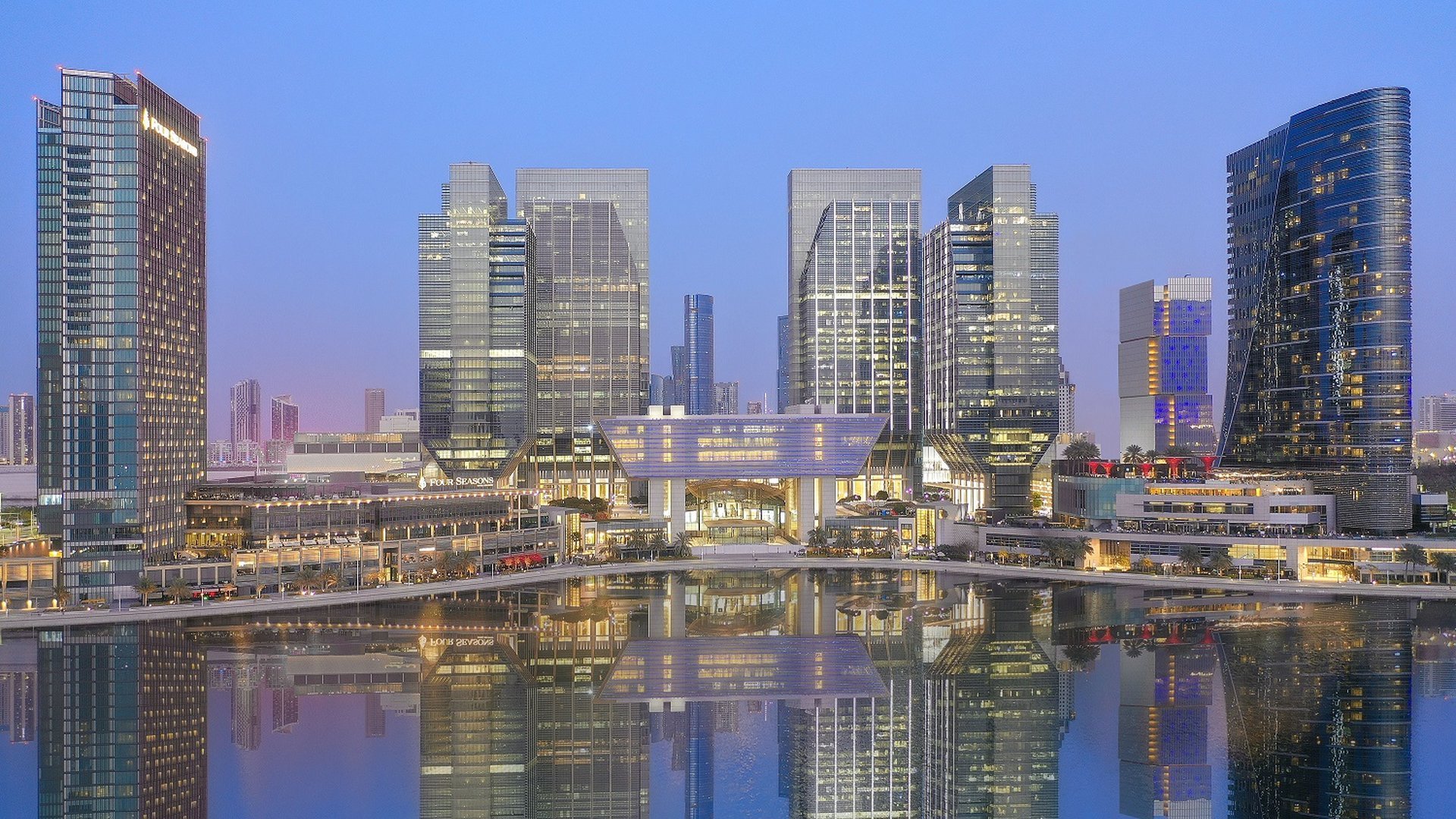
Here is the demand concentration reality: residential transaction activity and supply delivery in Abu Dhabi consistently cluster in a handful of investment zones, including Yas Island[23], Saadiyat Island[24], Al Reem Island[25], and Al Maryah Island[26]. CBRE’s 2022 note that these three islands accounted for ~66.6% of total sales activity is the strongest “where demand really transacts” proof point. [27] The supply story is equally concentrated: Asteco reports ~6,500 residential units delivered in 2023, largely across key investment zones (including Reem, Yas, Saadiyat, and areas like Al Raha Beach). [5] Knight Frank’s Winter 2024/25 pipeline: ~34,638 residential units under construction, scheduled for delivery by 2029, with apartments ~61% of pipeline. [7] Developer credibility as a market-making force. Abu Dhabi’s market is increasingly shaped by the credibility and pacing discipline of a few major players: Miral[28] is explicitly positioned as a destination builder; it was appointed destination manager of Saadiyat in 2022 and cites a 44% increase in visits to Saadiyat Island in 2023 vs 2022. Destination management is not a tourism footnote—it is rental demand engineering. [29] Modon Holding[30] has emerged as a major master developer across new waterfront plays and is scaling aggressively (including high-profile deals and rapid sell-outs reported in credible press). [31] Aldar’s own reporting shows a rising share of overseas/resident expat buyers in its UAE sales (e.g., 66% in 2023; 78% in 2024), indicating that the customer base has internationalised within flagship developers’ pipelines—even if that is not a full-market statistic. [32]
Abu Dhabi vs Dubai as a forward-looking positioning argument
The Dubai comparison should not be framed as “better/worse.” It should be framed as cycle maturity and supply elasticity. Dubai’s scale and volatility are both real. Knight Frank estimates ~302,880 homes under construction in Dubai due for completion by 2029 (~60,576 per year average), and warns this is above a long-term completion rate of ~36,000 per year. That’s not bearish by itself, but it’s the kind of pipeline that makes price growth mathematically harder to sustain. [33] Government reporting also shows Dubai’s transaction scale is vastly larger (e.g., Dubai Land Department reporting AED 761bn in “transactions” in 2024). Definitions differ across emirates, but the capital flow intensity is undeniable. [34] Abu Dhabi’s relative pitch: lower supply elasticity and later-cycle upside. In the same delivery window, Abu Dhabi’s pipeline is an order of magnitude smaller (~34.6k units by 2029). That does not guarantee higher returns—but it supports a stability premium: fewer simultaneous handovers mean less forced discounting if demand softens. [7] Here’s the nuance I would lean into as Ahmad Almudallal: Dubai is a liquidity market first (fast turnover, global visibility, reflexive cycles). Abu Dhabi is positioning itself as a quality-and-governance market (slower, more regulated, with destination demand compounding). In the next decade, Abu Dhabi’s edge is not “growth at any cost.” It’s growth with lower structural fragility—provided it manages island supply clustering and keeps regulation credible. [35]
Comparative snapshot table
Strategic advantage analysis with embedded risks and contrarian views
Compounding strengths (the 80% case) Demand is becoming structural, not cyclical. Tourism targets (39.3m visitors by 2030), airport capacity upgrades, and population growth (+7.5% in 2024) are the ingredients that turn real estate from an oil-correlated asset into a services-economy asset. [42] Regulation is moving toward institutional norms. Escrow and off-plan governance exist in law; service-charge monitoring is explicitly described as a multi-year policy framework; rental pricing is being indexed; and listings are being verified/centralised. These are not “nice to have”—they are precisely what offshore capital needs to price risk. [43] The premium-island focus creates scarcity—but only if pacing remains disciplined. Knight Frank’s data shows certain submarkets leading price growth (e.g., Saadiyat apartment growth of 18% in 2024) while the overall pipeline remains manageable. That is how luxury markets work: narrow, quality-driven outperformance creates brand equity for the location. [7] Financial-centre gravity is underrated as a residential driver. Expansion and scale-up of Abu Dhabi Global Market[44] is not just office absorption; it shapes the tenant base for premium apartments and executive rentals, especially around Al Maryah/Reem. Reuters reports strong growth in ADGM registrations and assets under management, and jurisdiction expansion to include Al Reem Island. [45] (Investor translation: a larger professional services ecosystem raises the floor under rentals, even if capital values cool.) Contrarian observation: the “safest city” narrative is not fluff; it is a conversion tool for family capital. Abu Dhabi’s long run at #1 in Numbeo’s safety ranking (cited officially by the Abu Dhabi Media Office) is part of why UAE wealth migration has a “sticky” quality—it supports long-duration residency decisions, not only weekend investment. [46] Professional risk awareness (the 20% case) Supply clustering risk is the real threat—not overall supply. Abu Dhabi can still create a micro-oversupply if multiple high-end phases hand over at once within the same island submarket. Knight Frank’s 2025–2029 pipeline framing makes this risk measurable. [40] Liquidity is thinner than Dubai by design. That is a feature in stable markets—but it can become a bug in a downturn, because price discovery can gap down when sellers need to exit quickly. Payment-plan “financialisation” can attract the wrong investors. More flexible instalment structures and lower resale thresholds increase participation, but they can import “assignment traders” who sell narratives, not assets. Abu Dhabi’s earlier history of tight resale restrictions is a reminder that developers will clamp down again if speculation becomes disorderly. [47] Advisor blind spot: net yield is where most projections die. Service charges, vacancy, and leasing friction matter more in Abu Dhabi than in Dubai because the “flip culture” is less liquid and the rental market historically had periods of softness. The good news is that service/community charges are being monitored and reduced; the bad news is that many advisors still underwrite using gross yield. [48]
Mandatory strategic research conclusion with an advisory stance
If I’m advising an investor on the 2015–2030 arc, my stance is: Abu Dhabi has moved from “local housing market” to “governance-led global allocation.” The evidence is not a single year of sales hype; it is the layering of regulatory protections (2015 law), operational transparency (service-charge monitoring + rental index + verified listings), and macro demand scaffolding (population growth, airport capacity, Tourism Strategy 2030). [49] Capital preservation logic (defensive): prime, well-managed, scarcity-defined assets in the best-performing investment zones—where demand is both resident-led and executive/expat-led—benefit from Abu Dhabi’s stability bias and governance upgrades. The goal is resilient occupancy and controlled net yield erosion via fee regulation. [50] Capital growth logic (offensive): targeted exposure to submarkets where the delta is still being priced in—new infrastructure nodes, destination-managed zones, and areas benefiting from financial-centre expansion. Growth depends on timing entries ahead of delivery clustering and avoiding “copy-paste” product. [51] Investor edge in the next 5–10 years: Abu Dhabi’s opportunity is not to mimic Dubai’s speed; it’s to compound credibility. The market will reward investors who buy the governance trend (transparency + regulated fees + verified data) and not just the skyline. [52] Written by Ahmad Almudallal: Advisor for global investors, founders, and UHNW families on acquiring capital-grade real estate in Abu Dhabi.
References
- [1] [12] [43] [49] [53] - Real Estate Legislations- — https://adrec.gov.ae/-/media/4844AFD706FC4D978777FF1A76FB6278.ashx
- [2] [36] Abu Dhabi Real Estate Centre records 24.2% growth in real estate transactions valued at AED96.2bn in 2024 — https://www.mediaoffice.abudhabi/en/economy/abu-dhabi-real-estate-centre-records-24percent-growth-in-real-estate-transactions-valued-at-aed96bn-in-2024/
- [3] [4] [5] [9] [59] cdn.aldar.com — https://cdn.aldar.com/-/media/project/asteco/asteco/pdf/20240207_astrep942_2023q4_abudhabi.pdf
- [6] [28] [57] Abu Dhabi Residential Market Review Winter 2022-23 – Final — https://www.knightfrank.ae/research/reports/abu-dhabi-residential-market-review-2366/contentassets/abu-dhabi-residential-market-review-winter-2022-23-9625.pdf
- [7] [23] [37] [40] [55] [58] knightfrank.ae — https://www.knightfrank.ae/research/reports/abu-dhabi-residential-market-review-2366/contentassets/abu-dhabi-residential-market-review-winter-2024-25-12221.pdf
- [8] [42] [56] Tourism Strategy 2030 - DCT Abu Dhabi — https://dct.gov.ae/en/who.we.are/tourism.strategy.2030.aspx?utm_source=chatgpt.com
- [10] [26] Abu Dhabi International Airport's Terminal A will open — https://www.mediaoffice.abudhabi/en/transport/abu-dhabi-international-airports-terminal-a-will-open-across-three-phases-starting-from-1-november-2023/?utm_source=chatgpt.com
- [11] [24] Abu Dhabi Emirate Population — https://census.scad.gov.ae/home/population?utm_source=chatgpt.com
- [13] [14] [21] [30] [38] ADREC launches first residential Abu Dhabi Rental Index — https://adrec.gov.ae/en/News/Newsitem7-ADREC-launches-first-residential
- [15] [44] Ghadan 21 — https://www.abudhabi.gov.ae/en/programmes/ghadan-21?utm_source=chatgpt.com
- [16] [34] Dubai's Real Estate Sector records AED761 billion in — https://dubailand.gov.ae/en/news-media/dubai-s-real-estate-sector-records-aed761-billion-in-transactions-in-2024?utm_source=chatgpt.com
- [17] [47] Aldar introduces strict resale restrictions as it reveals new Abu — https://www.thenationalnews.com/business/aldar-introduces-strict-resale-restrictions-as-it-reveals-new-abu-dhabi-housing-projects-1.688614?utm_source=chatgpt.com
- [18] How to Resale Off Plan Properties in Abu Dhabi – MyBayut — https://www.bayut.com/mybayut/resell-off-plan-property-abu-dhabi/?utm_source=chatgpt.com
- [19] Law No. (3) of 2015 Concerning the Regulation of the — https://adrec.gov.ae/-/media/4844AFD706FC4D978777FF1A76FB6278.ashx?utm_source=chatgpt.com
- [20] [48] [50] Abu Dhabi Real Estate Center Reveals Reduction in — https://adrec.gov.ae/en/News/Newsitem8-Abu-Dhabi-Real-Estate-Center-Reveals-Reduction?utm_source=chatgpt.com
- [22] [35] [52] Abu Dhabi Real Estate Centre introduces Gulf Region’s first multiple listing service platform, Madhmoun — https://www.mediaoffice.abudhabi/en/economy/abu-dhabi-real-estate-centre-introduces-gulf-regions-first-multiple-listing-service-platform-madhmoun/
- [25] [45] [51] Abu Dhabi's financial centre posts 32% growth in company registrations in 2023 — https://www.reuters.com/markets/abu-dhabis-financial-centre-posts-32-growth-company-registrations-2023-2024-03-06/?utm_source=chatgpt.com
- [27] [54] CBRE - UAE Market Estate Market Review Q2 2022 — https://argaamplus.s3.amazonaws.com/f83af09d-0c68-4de3-bf11-7ed5fdb401c5.pdf
- [29] About – Miral — https://miral.ae/about-miral/?utm_source=chatgpt.com
- [31] Modon Holding - Bringing Cities to Life — https://www.modon.com/?utm_source=chatgpt.com
- [32] ir.aldar.com — https://ir.aldar.com/2023/documents/Aldar-development_EN.pdf
- [33] [39] Dubai residential prices surge by 19% in 2024 amid rising — https://www.knightfrank.ae/newsroom/article/2025/3/dubai-residential-market-review---q4-2024?utm_source=chatgpt.com
- [41] Dubai real estate prices likely to face double-digit fall after years of boom, Fitch says — https://www.reuters.com/world/middle-east/dubai-real-estate-prices-likely-face-double-digit-fall-after-years-boom-fitch-2025-05-29/?utm_source=chatgpt.com
- [46] Abu Dhabi ranked world's safest city for 9th consecutive year — https://www.mediaoffice.abudhabi/en/security/abu-dhabi-ranked-worlds-safest-city-for-9th-consecutive-year/?utm_source=chatgpt.com
- [60] Can Expats Buy Property In Abu Dhabi? — https://bloomholding.com/articles/can-expats-buy-property-in-abu-dhabi?utm_source=chatgpt.com