A cultural anchor moves a market in three motions: sentiment, scarcity, footfall. Here is which one is still available to a Saadiyat buyer in 2026 — and which is already spent.
Abu Dhabi’s Dar Al Funoon Explained: Frank Gehry’s New Arts Landmark on Saadiyat Island Real Estate
By Ahmad Almudallal · 26 June 2026 · Market Analysis · 9 min read
Key takeaways
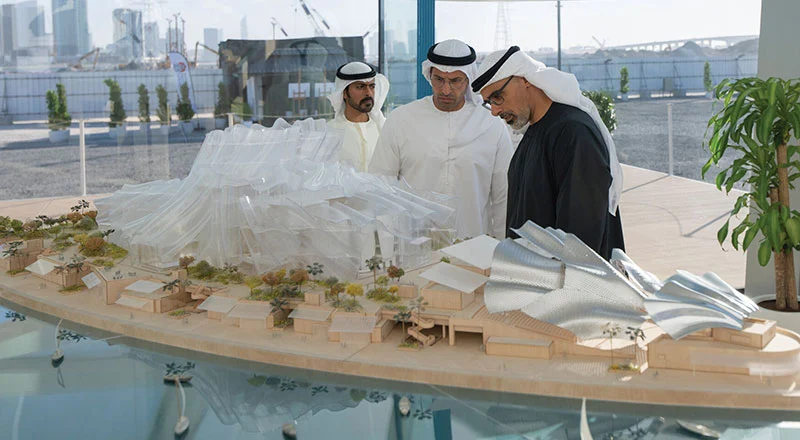
His Highness Sheikh Khaled bin Mohamed bin Zayed Al Nahyan, Crown Prince of Abu Dhabi and Chairman of the Abu Dhabi Executive Council, launched on Thursday 25/06/2026 the Dar al Funoon Abu Dhabi — House of the Arts — development project near Saadiyat Cultural District, Abu Dhabi.
Set to open in 2030, the project will become one of the region’s largest and most technically advanced performing arts venues, offering year-round artistic programming.
Dar Al Funoon Abu Dhabi, a Frank Gehry-designed performing-arts institution of more than 6,000 seats.
Exact location on Google Maps: https://maps.app.goo.gl/JMdKHtEP6eEcL3U99
Much of Saadiyat's cultural premium is already priced: the island rose roughly 27% per square foot in 2025, before this project was announced.
For a serious buyer, this is a positioning decision across the holding period, not an event to trade at launch.
Introduction
On 25 June 2026, Abu Dhabi began work on Dar Al Funoon — "House of the Arts" — a performing-arts institution designed by Frank Gehry, on Saadiyat Island, next to the Saadiyat Cultural District. The Crown Prince of Abu Dhabi, Sheikh Khaled bin Mohamed, witnessed the launch and reviewed the build. The headline writes itself: another Gehry building, another reason Saadiyat goes up.
The headline is also where most buyers go wrong. A cultural anchor does change the value of the land around it — there is a documented history here, and Gehry is at the centre of it. But it does not do so in a single motion, and it does not do most of its work in the week the news breaks. The useful question is not whether Dar Al Funoon lifts Saadiyat. It is which part of that lift is still available to a buyer in 2026, and which part has already been spent.
What was actually announced
Dar Al Funoon was commissioned by the Department of Culture and Tourism – Abu Dhabi and designed by Gehry, in one of his final two works before his death in December 2025 at the age of 96 — the other being Guggenheim Abu Dhabi, also on Saadiyat. He won the commission through a design competition. The institution is planned across four venues, with more than 6,000 seats in total, and is intended to run programming across all 365 days of the year from its 2030 opening.
Containing the following venues:
1-Main multipurpose hall : 2,000+ capacity for Opera, ballet, theatre, orchestral concerts, musicals
2-Open-air amphitheatre: 3,500 capacity for Festivals, large outdoor performances
3-Studio theatre: 400 capacity for Intimate and adaptable formats
4-Jazz venue : 250 capacity for Small-format live music
-Total: 6,000+ capacity for all the arts campus/venues
The main hall is publicly described as carrying an orchestra pit for up to 120 musicians. The building's form — a billowing, fabric-like exterior with a transparent façade, drawn from the movement of wind and water — is recognisably Gehry. The investment figure has not been disclosed; the DCT chairman, Mohamed Khalifa Al Mubarak, declined to state it. Named performers raised in interviews — from Emirati and Arabic voices to Ludovico Einaudi, Max Richter, Hamilton and Dave Chappelle — are indicative of ambition, not a confirmed calendar.
Does a landmark like this actually raise nearby property values?
This is the question brokers answer with a slogan and serious buyers answer with evidence. The evidence exists, and it has a name. When Gehry's Guggenheim opened in Bilbao in 1997, it became the standard reference for culture-led urban regeneration — the "Bilbao effect." The museum has drawn roughly seven million visitors, around 60% from abroad, and the public investment behind it was recovered within about six years. A declining industrial city repositioned itself around a single building and the district that grew around it.
There is a detail here that is more than poetic. Bilbao's form was famously described as billowing and nautical — sails, waves — the same formal language now rising on Saadiyat, from the same architect. Dar Al Funoon is, in a real sense, a later chapter of the building that taught the world this strategy.
But an advisor has to give you the other half, because it is the half that protects you. The scholarly literature on the Bilbao effect is split. A body of urban-research work argues the effect is hard to replicate, that it depends on integrated planning rather than a single spectacle, and that cities chasing the building without the surrounding strategy have been disappointed. The honest version is this: a cultural anchor can lift the value around it, durably — but it is a contributor, not a guarantee, and it is the contribution that lands last.
How a cultural anchor moves a market: the three clocks
A cultural anchor does not move property value in one motion. It runs three clocks, each on a different timescale, each rewarding a different kind of buyer.
The Announcement Clock — sentiment. This runs in days. Gehry's name, the renders, the launch coverage. It is real, but it is shallow and partly reflexive: it prices in quickly and can fade. A buyer who acts only because of the announcement is usually paying for a story the market has already absorbed.
The Construction Clock — scarcity. This runs across the build, 2026 to 2030. The binding constraint in this phase is not the building; it is land. Saadiyat is a finite island whose cultural-district designation fixes its character and limits its supply, while each institution that completes deepens the district's credibility and absorbs new wealth arriving in the emirate. This is the window a patient buyer actually captures — not on narrative, but on fundamentals, held through time.
The Operating Clock — footfall and brand. This runs from 2030 onward, indefinitely. Once year-round programming begins, the island shifts from a daytime-museum destination into an evening-and-year-round one, broadening who comes, when, and for how long. This is the Bilbao layer — the durable, compounding one — and it lands only after opening, and only if the programming and the integration deliver.
The reading that follows is the one that matters: Dar Al Funoon is not a 2026 event to chase. It is a 2026–2035 accretion to position for. The shallowest and most-spent value is the headline. The durable value accrues across the construction decade and beyond.
Is Saadiyat's cultural premium already priced in?
Partly — and a buyer who does not know this overpays. Saadiyat recorded roughly a 27% rise in price per square foot across 2025, reaching the highest luxury-apartment rate in the emirate at about AED 2,932 per square foot, on the strength of its existing cluster — Louvre Abu Dhabi, Manarat Al Saadiyat, the Zayed National Museum and Natural History Museum, with Guggenheim Abu Dhabi still to come. A AED 400 million-plus mansion changed hands on the island in late 2024. The Announcement Clock for Saadiyat's cultural identity has been ticking for years; Dar Al Funoon extends it, it does not start it.
This is the misread to avoid. "A new landmark is coming, so buy now before prices rise" treats a 2030 institution as a 2026 catalyst. The catalyst already largely happened. What is still available is the construction-decade accretion and the post-opening operating layer — and both reward fundamentals and patience, not a launch-week premium.
What a 2030 opening means for a 2026 buyer
It means this is a positioning decision, not an event trade. The supporting market is doing the heavy lifting independently of any single building. Abu Dhabi's valuation-based price index rose 17.8% year-on-year in Q1 2026, with apartments up 22.7%; the emirate recorded its strongest quarter on record at AED 38.1 billion in residential sales, roughly 8,100 transactions, with off-plan around 90% of value. Forecasters expect around 16% capital-value growth for 2026 against a thin pipeline of roughly 6,500 deliveries. Underneath sits genuine wealth migration — about 7,200 millionaires entered the UAE in 2025 — and Knight Frank now describes Abu Dhabi as an emerging base for ultra-high-net-worth individuals who want a lower-profile life.
For a buyer, that combination — a supply-fixed prime island, a freehold zone, zero income and capital-gains tax, a structurally appreciating market, and a cultural anchor that compounds to 2030 — is a holding-period asset by design. The timeline is the thesis, not an obstacle to it.
Considerations a serious buyer manages
The case is strong; the discipline is what keeps it that way.
First, part of the premium is already in the price. That is the reason to enter on fundamentals — location, scarcity, building quality — rather than on the headline, and to treat the construction decade, not launch week, as the window. Second, 2030 is a long horizon; but a culture-anchored, supply-fixed, tax-free freehold island is built to be held, so the horizon is the point. Third, the Bilbao effect is not automatic; Saadiyat's defence is that its demand has a structural floor — scarcity, wealth migration, a schools-and-culture cluster, sovereign backing — beneath the sentimental layer, so the operating upside is a bonus on a base that already performs. Fourth, regional geopolitics moves sentiment, as a softer March 2026 showed; through that same period Abu Dhabi proved the more resilient of the two UAE markets and still set a record quarter.
Strategic takeaway
The ordinary buyer sees a new Gehry building and reads it as a reason to act this week. The serious buyer sees three clocks — and recognises that the one generating headlines is the one already spent. The value still on the table is the construction-decade scarcity and the post-2030 operating layer, and both are captured the same way: by acquiring the right asset on the island on fundamentals, and holding it through the decade the institution takes to mature. Dar Al Funoon strengthens the long case for Saadiyat. It does not change the discipline for entering it.
References
The National — "Abu Dhabi announces new Frank Gehry-designed performing arts venue to open in 2030" (25 Jun 2026). https://www.thenationalnews.com/arts-culture/2026/06/25/dar-al-funoon-abu-dhabi-new-arts-venue-saadiyat-island/
The National — "Abu Dhabi announces 'a place for all' with new Dar Al Funoon" (interview, 25 Jun 2026). https://www.thenationalnews.com/arts-culture/2026/06/25/dar-al-fanoon-abu-dhabi-house-of-the-arts-frank-gehry/
PR Newswire / DCT Abu Dhabi — official announcement (25 Jun 2026). https://www.prnewswire.com/news-releases/abu-dhabis-cultural-vision-strikes-a-new-note-with-landmark-performing-arts-institution-dar-al-funoon-abu-dhabi-302810733.html
Gulf News — "Abu Dhabi begins work on Frank Gehry-designed Dar al Funoon" (25 Jun 2026). https://gulfnews.com/uae/abu-dhabi-begins-work-on-frank-gehry-designed-dar-al-funoon-on-saadiyat-island-1.500586858
Khaleej Times — "New artistic landmark designed by Frank Gehry to open in Abu Dhabi in 2030" (25 Jun 2026). https://www.khaleejtimes.com/uae/abu-dhabi-new-landmark-frank-gehry-deign-dar-al-funoon
Arab News — "Abu Dhabi announces Frank Gehry-designed performing arts center" (25 Jun 2026). https://www.arabnews.com/node/2648581/lifestyle
Bayut — Abu Dhabi Sales Market Report 2025. https://www.bayut.com/mybayut/abu-dhabi-sales-market-report-2025/
ValuStrat — Abu Dhabi Real Estate Market Outlook 2026. https://valustrat.com/products/abu-dhabi-real-estate-market-outlook-2026
Economy Middle East — "Abu Dhabi real estate in 2026: residential capital growth hits 16 percent" (28 Jan 2026). https://economymiddleeast.com/news/abu-dhabi-real-estate-2026-apartment-values-projected-to-outshine-villas-as-residential-capital-growth-hits-16-percent/
Knight Frank — The Wealth Report / Prime Index 2026. https://www.knightfrank.com/research/article/2026/4/piri-100-ultimate-prime-residential-property-index
The National — "Where are UAE residential prices and rents heading in 2026?" (Henley millionaire data). https://www.thenationalnews.com/business/property/2025/12/30/apartment-for-rent-dubai-abu-dhabi-rental-index-2026-property-for-sale/
Global Property Guide — UAE Residential Market Analysis 2026 (ValuStrat Q1 data). https://www.globalpropertyguide.com/middle-east/united-arab-emirates/price-history
Resident.com — "Abu Dhabi's Landmark Districts and the Attraction Economy" (14 Jan 2026). https://resident.com/resource-guide/2026/01/14/abu-dhabis-landmark-districts-and-the-attraction-economy
B. Plaza — "The Return on Investment of the Guggenheim Museum Bilbao" (IJURR, 2006). https://www.researchgate.net/publication/4761544_The_Return_on_Investment_of_the_Guggenheim_Museum_Bilbao
Apollo Magazine — "Is the Bilbao effect over?" https://apollo-magazine.com/is-the-bilbao-effect-over-guggenheim/
The Museum Review — del Cerro Santamaría, "Iconic architecture and the end of the Bilbao Effect" (2020). https://themuseumreviewjournal.wordpress.com/2020/09/22/tmr_vol5no1_delcerrosantamaria/
Mitchell's Commercial Realty — weekly insights citing Cavendish Maxwell Q1 2026 Abu Dhabi data (20 Jun 2026). https://www.mitchellscommercialrealty.com/post/weekly-insights-dubai-property-investors-june-20-2026
Property Finder — Saadiyat Island property guide / price bands. https://www.propertyfinder.ae/en/buy/abu-dhabi/properties-for-sale-saadiyat-island.html