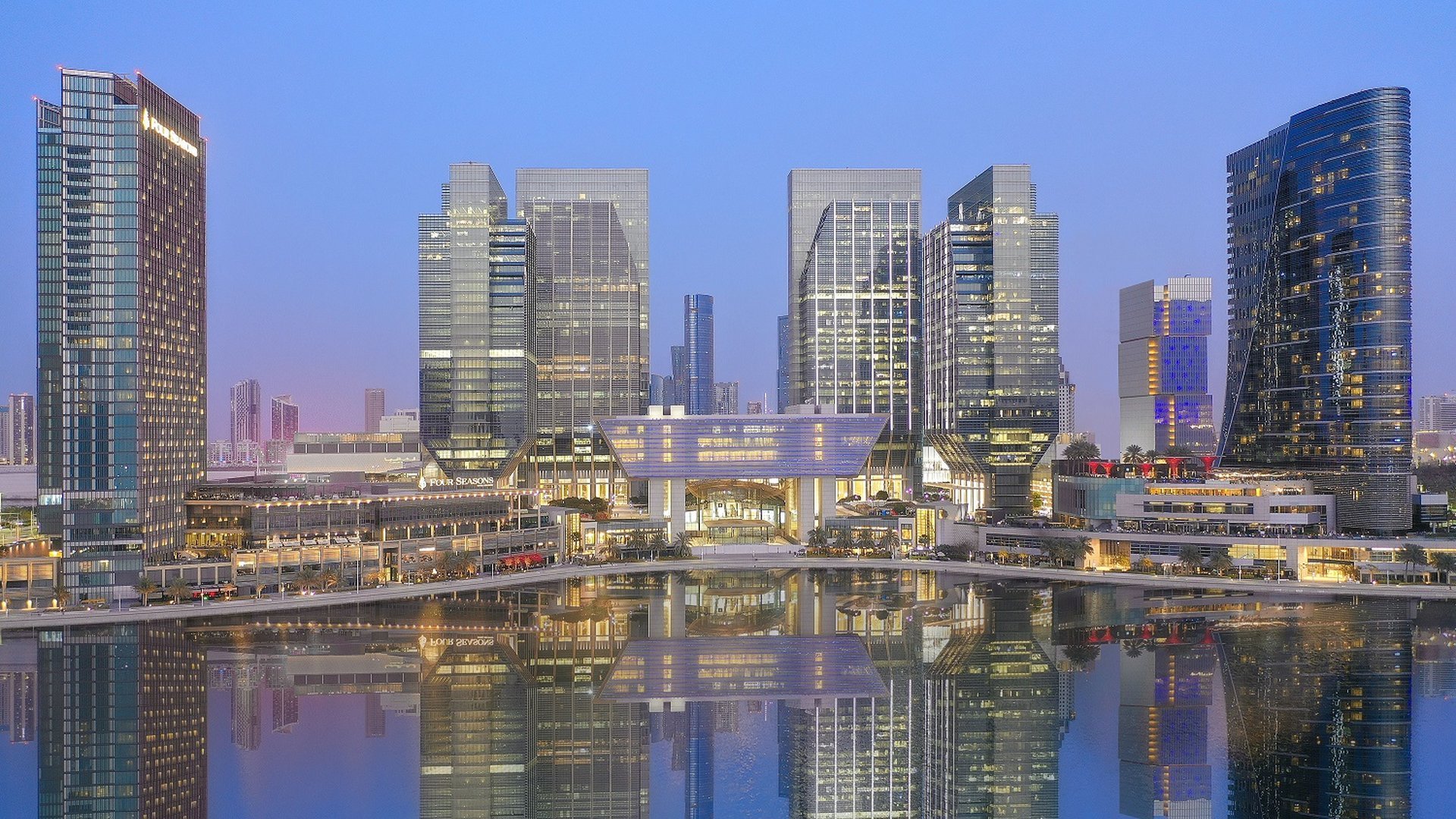
An advisory analysis of the only address in Abu Dhabi where an English-common-law financial centre (ADGM), hotel-grade branded living, and a finite waterfront landbank converge — and what the AED 60bn+ Al Maryah expansion means for long-horizon buyers.
Al Maryah Island: Why Abu Dhabi's Financial District Is Becoming a Branded-Residence Stronghold
An advisory analysis of the only address in the capital where an English-common-law financial centre, hotel-grade branded living, and a finite waterfront landbank converge — and what that convergence means for buyers who think in decades, not seasons.
The central argument of this piece is uncomplicated, but its consequences are not: Al Maryah Island is not simply another freehold zone competing on view, finish, and payment plan. It is the one place in Abu Dhabi where the institution and the residence sit on the same square kilometre. The institution is ADGM — Abu Dhabi Global Market — the emirate's international financial centre, which governs the island under the direct application of English common law. The residence is increasingly branded: St. Regis, W, and Ritz-Carlton names are now attached to towers on or beside the island. For a buyer trying to separate durable value from cyclical noise, that pairing is the whole story, and most marketing material never explains why. [1] [2] [3]
The institution beneath the address
Most island pitches lead with lifestyle. Al Maryah's most important feature is legal. ADGM was established in 2013 and became operational in October 2015 as the international financial centre and free economic zone of Abu Dhabi. Crucially, it is the only jurisdiction in the region to apply English common law directly — including precedent from the courts of England and Wales — without codification or translation, through its own independent ADGM Courts of First Instance and Appeal. [1]
Why should a residential buyer care about a commercial-law framework? Because the same ecosystem that gives a hedge fund or a family office confidence to domicile capital on the island also shapes the population that will live, rent, and transact there. ADGM crossed 11,000 active licences in the first half of 2025, making it the largest and fastest-growing financial hub in the MENA region, with roughly 40,000 people already based inside the district. [2] [4] A residence is ultimately a claim on future demand; on Al Maryah, that demand is anchored to an institution rather than to a marketing cycle.
> An advisory rule I repeat often: buy the address that is hardest to replicate. Beaches can be reclaimed and towers can be cloned, but a functioning international financial centre with its own common-law courts cannot be conjured next door. That scarcity is the quiet engine under Al Maryah pricing.
The supply shock that reframes the thesis
For years the strategic weakness of Al Maryah was size — a compact island with limited room to grow. That constraint was decisively addressed in December 2025, when Mubadala and Aldar announced a joint venture to expand the island with a gross development value exceeding AED 60 billion. The north side of Al Maryah — its final undeveloped landbank, spanning almost 500,000 square metres — will deliver around 1.5 million square metres of new office, residential, retail, and hospitality space. [3]
The detail that matters most for residential buyers sits inside that announcement: the expansion is expected to add more than 3,000 luxury waterfront residences, while doubling the island's Grade A office supply with over 450,000 square metres of additional offices. In other words, the same project that deepens the demand side (more firms, more senior professionals) also expands the supply side (more homes). [3]
| Metric | Figure | Why it matters to a buyer |
|---|---|---|
| Gross development value | AED 60bn+ | Signals sovereign-backed, long-horizon commitment to the island |
| New gross floor area | ~1.5m sqm | Reshapes the island from compact to comprehensive |
| Additional Grade A office | 450,000+ sqm (doubles supply) | More senior tenants → deeper rental and resale demand |
| New luxury residences | 3,000+ waterfront homes | Raises future supply; selectivity becomes essential |
| New connectivity | 3 bridges, Saadiyat <10 min | Reduces the island's historic isolation premium-risk |
This is where critical thinking has to replace enthusiasm. A development that simultaneously grows demand and supply is not automatically bullish for every unit. It is bullish for scarce, well-located, brand-anchored stock and potentially diluting for generic product bought purely on a payment plan. The expansion rewards selectivity, not indiscriminate exposure.
Why "branded" is the rational response to that supply
When a district is about to absorb thousands of new homes, the buyer's defence against future dilution is differentiation that cannot be easily reproduced. This is precisely the structural reason branded residences have moved, in my view, from a premium novelty to a capital-formation strategy. The data supports the instinct rather than merely the marketing: Savills' 2025/2026 branded-residences research puts the global average premium at roughly 33% over comparable non-branded stock, with urban markets near 30% and resort markets near 39%, while Knight Frank's parallel work lands at a consistent ~30% headline. [5] [6]
Abu Dhabi specifically is where this trend is accelerating fastest. CBRE's 2025 UAE branded-residences work describes the capital as an increasingly exclusive market, citing a sharp rise in transaction volumes and notably high premiums for branded units. On Al Maryah, that abstraction has names: SAAS is delivering the Ritz-Carlton Residences, the St. Regis Residences bring Marriott's flagship service brand to the island, and Taraf's W Residences add a 177-home, 37-storey lifestyle tower in the 1–4 bedroom range. [3] [7]
| Branded scheme (Al Maryah area) | Operator brand | Buyer logic |
|---|---|---|
| St. Regis Residences | Marriott / St. Regis | Butler-led service heritage; trophy-address recognition |
| W Residences | Marriott / W (by Taraf) | Lifestyle brand; younger UHNW and rental appeal |
| Ritz-Carlton Residences | Marriott / Ritz-Carlton (by SAAS) | Service-standard certainty; resale brand strength |
The branded premium is not magic. It is paid for measurable things: hotel-grade service-level agreements, design and build quality held to brand standards, and — most relevant in a high-supply district — brand recognition at resale, which narrows the buyer's exit risk when generic competitors flood the secondary market.
The contrarian risks the brochures omit
Honest advisory work means naming what could go wrong. Three risks deserve scrutiny on Al Maryah specifically.
First, supply absorption timing. Three thousand new homes plus surrounding launches must be absorbed by real households, not spreadsheets. If delivery clusters into a narrow window, early resale liquidity can soften even for good product — which is an argument for staggered entry and for favouring schemes with credible handover track records.
Second, the branded-fee burden. The same service agreements that justify the premium also carry ongoing fees. A branded residence is only "worth it" if the operator sustains the standard for the life of the asset; buyers should read the operator agreement, the service-charge structure, and the brand-term length before being seduced by the lobby.
Third, regulatory novelty around property. ADGM's Registration Authority has been extending its remit over real property (notably across the adjacent Al Reem Island under the 2024 Real Property Regulations and the AccessRP platform). This is a net positive for transparency, but it is new, and buyers should confirm exactly which registration and conveyancing regime applies to a specific tower before signing. [1]
What an advisor actually does here
The practical value of specialist advice on Al Maryah is not access to a brochure — those are everywhere. It is the discipline to ask the unglamorous questions: Is this specific unit differentiated enough to survive the coming supply? Does the operator agreement protect the premium for fifteen years, not five? Is the payment plan structured to match a realistic absorption curve? And does the registration regime for this exact building give a clean, defensible title?
> My own focus is deliberately narrow: high-end and elite, luxury-level homes — and within that, branded residences and Al Maryah Island in particular. Narrow focus is not a limitation; on an island where an institution, a brand, and a finite landbank intersect, it is the only way to tell durable value from packaging.
Conclusion
Al Maryah Island is moving from "Abu Dhabi's financial district with some apartments" to a fully formed branded-residence destination backed by a AED 60-billion-plus, sovereign-led expansion. The convergence is genuinely rare: an English-common-law financial centre, a deepening pool of senior international professionals, and a tightly governed waterfront finally given room to grow. That combination argues for more selectivity, not less. The expansion will reward buyers who choose scarce, brand-anchored, well-located stock and read the fine print — and it will gently penalise those who buy generic product on a payment plan alone. For investors who think in decades, Al Maryah is no longer a niche on the map of Abu Dhabi luxury; it is one of its most defensible addresses, and the branded tower beside the financial centre is the clearest expression of why.
References
- [1] Abu Dhabi Global Market — Wikipedia — https://en.wikipedia.org/wiki/Abu_Dhabi_Global_Market
- [2] ADGM, the international financial centre of Abu Dhabi — Al Maryah Island — https://almaryahisland.ae/business/abu-dhabi-global-market/
- [3] Mubadala and Aldar Announce Landmark AED 60+ Billion Expansion of Abu Dhabi's Financial District on Al Maryah Island — ADGM (8 Dec 2025) — https://www.adgm.com/media/announcements/mubadala-and-aldar-announce-landmark-aed-60-billion-expansion-of-abu-dhabis-financial-district-on-al-maryah-island
- [4] ADGM largest international financial centre in MENA, with 11,000+ active licences at end of H1 2025 — Abu Dhabi Media Office — https://www.mediaoffice.abudhabi/en/economy/adgm-largest-international-financial-centre-in-mena-with-11000-plus-active-licences-at-end-of-h1-2025/
- [5] Branded Residences 2025/2026 — Savills Research — https://www.savills.com/research_articles/255800/386765-0
- [6] The Residence Report 2025/26 — Knight Frank — https://content.knightfrank.com/research/3041/documents/en/the-residence-report-202526-12403.pdf
- [7] UAE Branded Residences Report 2025 — CBRE — https://www.cbre.ae/insights/figures/uae-branded-residences-report-2025