Analysis to why Abu Dhabi announced 0% Rent increase until further notice
MARKET INTELLIGENCE
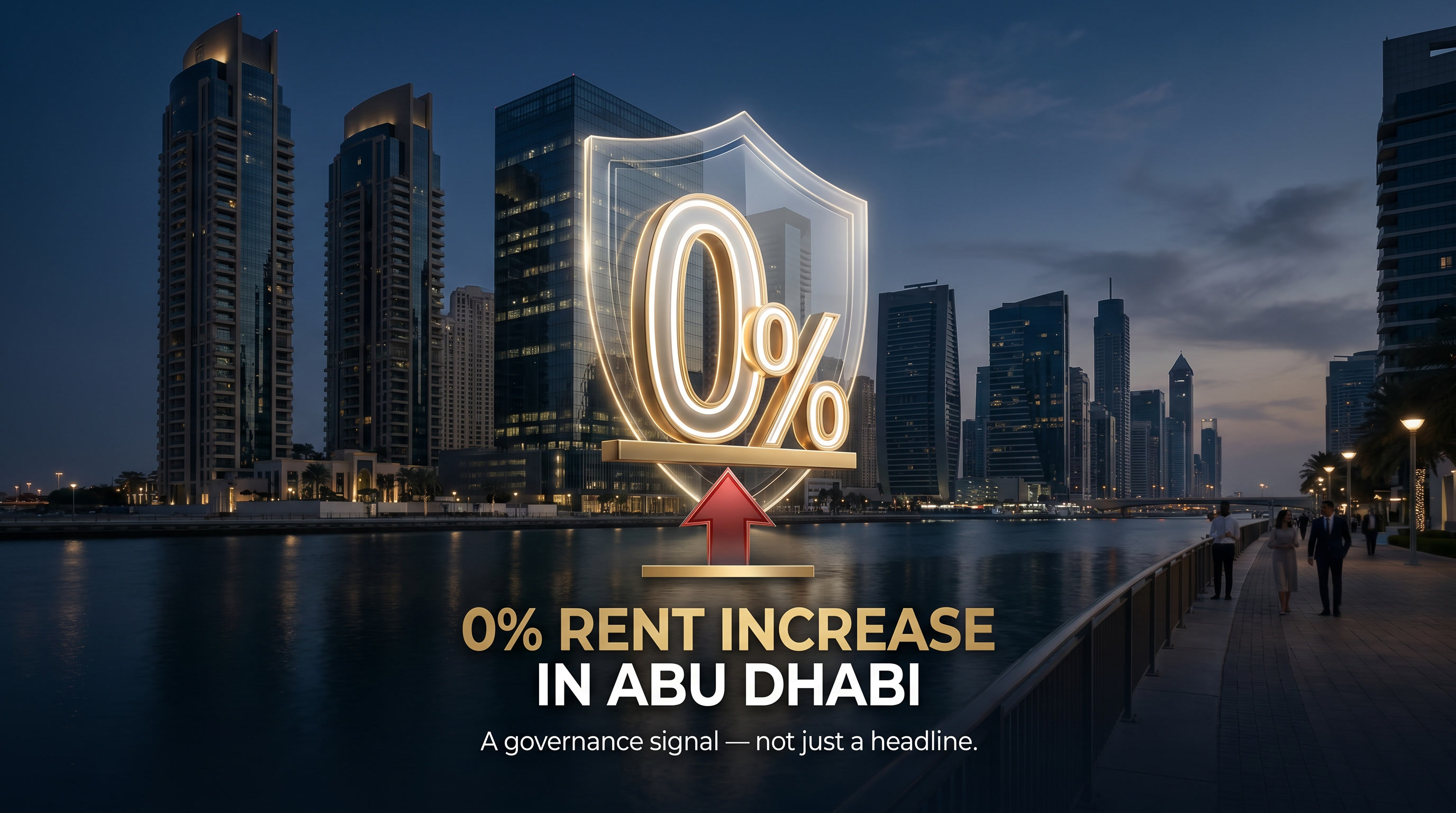
The Abu Dhabi Rent Freeze: Reading the Signal, Not the Headline
A 0% cap was reported as tenant relief. For anyone allocating capital rather than renewing a lease, the more useful story is what it reveals about how Abu Dhabi intends to be governed.
By Ahmad Almudallal · June 2026 · ~7 min read
Key takeaways
|
What is the Abu Dhabi rent freeze?
On 2 June 2026, ADREC took the annual rent-increase cap from 5% to zero — residential, commercial, industrial, emirate-wide, immediate, “until further notice.” For the nearly ten years since the framework was set in 2016, landlords could raise rents up to 5% a year. That headroom is now gone.
The reporting was correct on its own terms: relief for tenants, pressure on landlords. But that framing answers a tenant's question. The reader allocating capital needs a different one — and the rest of this analysis answers it.
Why did Abu Dhabi freeze rents now?
The freeze met an exceptionally tight market, not a weak one. Occupancy has run above 95%. New-lease prices rose roughly 15% across the emirate over the year, and about 23% in investment zones, per ADREC. Colliers put Q1 2026 apartment-rent growth near 15%, with some mid-market stock above 20%.
Two structural facts made it worth acting on. Around 71% of occupied residential stock is rented (ADREC's 2025 report), so rent is the housing reality for most of the city, not a niche concern. And supply offers no fast relief: ValuStrat data indicates only about 13% of 2026's expected residential supply arrived in Q1, with no acceleration likely before 2028. Add regional stress on jobs and household budgets, and a government watching rents accelerate into a squeezed population chose stability over letting the market clear.
Does the rent freeze affect property values?
This is the distinction most coverage misses, and it decides everything.
A rent freeze constrains income growth. It does not constrain capital value. Different variables, different investors, opposite outcomes.
A leveraged investor whose return depends on rising rents feels a real squeeze — the double-digit rental upside some zones were expected to deliver is precisely what the freeze prevents. But prime Abu Dhabi is not, in the main, a leveraged-yield market. Around 87% of 2026 transactions in the emirate are cash. At the top end, the thesis is capital appreciation, scarcity, and increasingly legacy — Knight Frank notes Abu Dhabi is emerging as a base for UHNWIs wanting a lower-profile life. Capital values aren't frozen; they're still forecast in the mid-teens for 2026. So the freeze lands hardest on the segment least relevant to long-horizon buyers, and lightest on the one most relevant to them.
Two investors, two outcomes
Leveraged yield investor | Prime / cash allocator | |
Return driver | Rental income & yield | Appreciation, scarcity, lifestyle |
Freeze exposure | High — income capped | Low — value uncapped (~+15–16% forecast) |
Financing | Leverage | Mostly cash (~87% market-wide) |
Net read | Near-term ROI compression | Neutral-to-positive stability signal |
Figures: ADREC and ANAROCK; current market estimates.
Which areas are exempt from the Abu Dhabi rent freeze?
One: the ADGM jurisdiction — Al Maryah Island and Al Reem Island — under separate governance. Reported as trivia, it's strategic. The emirate now runs two rental regimes at once: a frozen mainland and a small set of zones where pricing stays free. Al Reem is an active rental-yield district, so for income-led capital, where you own now decides whether the freeze touches you at all. That asymmetry deserves deliberate attention, not accidental discovery.
What does the freeze actually signal to investors?
Three implications follow for the serious buyer.
The supply story is unchanged and still dominant. A freeze builds no homes; with the pipeline thin until at least 2028, the scarcity underpinning prime values persists.
The jurisdiction signal is favourable. Capital moving into Abu Dhabi is often moving away from places where rules feel arbitrary. A regulator intervening deliberately, transparently, and for long-term stability demonstrates exactly the predictability such capital prizes — Cavendish Maxwell read the move as strategic stability management, not a reaction to any single event. For a ten-year holder, that is a feature.
And strategies must be sorted, not lumped. Income-led approaches need re-underwriting; value-led ones largely don't. The honest conclusion is segment-specific — which is the point.
What are the risks?
Three genuine ones, stated plainly. Developer sentiment is exposed: Sico Bank flagged the freeze as potentially negative for Aldar and cautioned it could soften off-plan demand if rental-income expectations fall.
“Until further notice” is real ambiguity — open-ended measures are harder to underwrite, and the eventual unwind will itself move the market. And held long enough, any rent control tends to discourage new rental supply; the risk here is real only if “temporary” lengthens.
Strategic takeaway The freeze is a liquidity-and-stability event, not a value event. It compresses near-term income for the leveraged, leaves the prime appreciation thesis substantially intact, quietly elevates the exempt ADGM zones for yield-seekers, and reaffirms that the binding constraint is supply, not regulation. The ordinary reading is “rents are frozen.” The strategic reading is “a government is signalling how it intends to govern a market that capital is increasingly choosing.” Those are not the same sentence — and the gap between them is where decisions get made. |
Conclusion
Headlines compress; capital decisions shouldn't. For a tenant, the freeze is simple and welcome. For an investor, it's a prompt to ask a sharper question than good-or-bad — namely, good or bad for which strategy, in which zone, over what horizon. For prime, cash-led, long-horizon ownership in a supply-constrained, increasingly safe-harbour city, the answer sits closer to reassuring than alarming.
Sources
ADREC (2–3 June 2026); The National; Khaleej Times; Gulf News; AGBI; enterpriseAM; Colliers Q1 2026; ValuStrat; ANAROCK; Knight Frank Wealth Report 2026; Cavendish Maxwell; Sico Bank. Figures are current estimates as of June 2026, attributed to source; forecasts and opinions labelled as such.